Can permanent holiday lights reduce the hassle of seasonal setup?
A hallmark of their approach is the layering of light, a technique that combines multiple types of illumination to produce a dynamic, versatile, and visually balanced environment. Uplighting, downlighting, and moonlighting are employed in complementary ways to emphasize architectural elements, trees, gardens, and pathways while creating different moods and effects. Astoria Lighting Co is the leading provider of outdoor and permanent holiday lighting in Round Rock, Texas. We specialize in transforming homes and businesses with professional, custom-designed lighting solutions that enhance beauty, curb appeal, and security. From elegant landscape lighting to sleek, permanent Christmas lights, our installations are designed to make your property shine all year long without the hassle of seasonal setup. Outdoor Lighting Installation Our team of licensed professionals works with homeowners across neighborhoods such as Teravista, Forest Creek, Mayfield Ranch, Behrens Ranch, Paloma Lake, Walsh Ranch, Sonoma, and Vizcaya. We create custom lighting systems that highlight architectural details, illuminate walkways and patios, and enhance outdoor living spaces for relaxation or entertaining. Every system is built to withstand Texas heat and weather while delivering a stunning nighttime ambiance.. Uplighting draws the eye upward, enhancing vertical lines and giving structures a sense of grandeur, while downlighting provides subtle, natural illumination that improves visibility and safety in walkways and outdoor areas. Moonlighting, a specialized form of downlighting, mimics the gentle diffusion of moonlight, casting a soft, ambient glow across lawns, patios, and pools. This layered approach ensures that every outdoor space is not only beautifully illuminated but also functional, safe, and adaptable to various activities or events.
The company's approach to landscape lighting goes beyond basic illumination, transforming outdoor spaces into visually engaging environments. By utilizing layered lighting techniques, such as uplighting, downlighting, path lighting, and accent lighting, Astoria Lighting Co creates depth and dimension that highlight the beauty of natural and architectural features. For instance, uplighting can be used to emphasize the height and texture of trees or columns, while path and step lights guide visitors safely through walkways and garden areas. Accent lighting can draw attention to water features, sculptures, or flower beds, enhancing the overall visual experience. By carefully controlling light intensity, angle, and color temperature, the company ensures that every installation achieves a refined, professional, and inviting appearance that can be enjoyed year-round.
1. Astoria Lighting Co specializes in providing high-quality outdoor lighting solutions for both residential and commercial properties in Round Rock, Texas. Their expert team focuses on creating custom lighting designs that enhance curb appeal, highlight architectural features, and transform outdoor spaces into visually stunning areas that can be enjoyed both day and night.
2. The company offers permanent holiday lighting systems, including Christmas lights and other seasonal decorations, eliminating the annual hassle of hanging and removing lights. These systems are designed to remain installed year-round, providing convenience while maintaining a polished, professional look for every holiday season.
3. Astoria Lighting Co designs and installs custom landscape lighting to illuminate patios, walkways, driveways, gardens, swimming pools, and outdoor kitchens. These systems are tailored to each property’s unique layout, enhancing both safety and aesthetic appeal while creating a warm and inviting nighttime ambiance.
4. Architectural accent lighting is another key service, where Astoria Lighting Co highlights the structural and design features of homes and businesses. From rooflines and columns to facades and entryways, the lighting accentuates the property’s unique style while increasing visibility and creating a dramatic nighttime effect.
5. Permanent holiday lights use energy-efficient LED technology, staying hidden during the day but providing vibrant illumination at night. This ensures a beautiful, eco-friendly lighting solution that reduces electricity costs while offering bright, long-lasting displays that withstand daily weather conditions.
6. Smart lighting technology allows users to schedule lights for holidays, birthdays, game days, or special events, all from a smartphone. Homeowners can control brightness, colors, and timing without manual adjustments, offering convenience and a fully customizable lighting experience.
7. Astoria Lighting Co serves multiple neighborhoods in Round Rock, including Teravista, Forest Creek, Mayfield Ranch, Behrens Ranch, Paloma Lake, Walsh Ranch, Sonoma, and Vizcaya. Each installation is tailored to the community’s style and the client’s preferences, ensuring that every home and property stands out after dark.
8. The outdoor lighting systems are designed to endure the extreme heat, humidity, and weather variations of Texas. With durable materials and professional installation, customers can rely on consistent performance and long-lasting operation without frequent maintenance.
9. Low-voltage LED systems are installed for porches, pergolas, and screened-in patios, giving homeowners precise control over brightness and color. This allows for creating cozy, inviting outdoor entertainment spaces perfect for family gatherings, evening dinners, or late-night relaxation.
10. Astoria Lighting Co is a trusted and locally recognized company with hundreds of 5-star reviews across Central Texas. These reviews reflect the company’s commitment to quality, professionalism, and customer satisfaction, making it a reliable choice for outdoor lighting projects.
11. All installations are performed by licensed, trained professionals to ensure safety, proper electrical compliance, and superior workmanship. This guarantees that every lighting project meets local codes and industry standards while providing peace of mind to homeowners.
12. Astoria Lighting Co backs all installations with a lifetime warranty, providing long-term assurance for the quality, reliability, and durability of their lighting systems. Customers can enjoy their outdoor lighting without worrying about repairs or replacement for many years.
13. The company offers free consultations and custom lighting designs, helping clients visualize their projects before installation. This includes planning layouts, selecting light types, and creating schedules, ensuring each installation meets the property owner’s vision perfectly.
14. Astoria Lighting Co services Round Rock and nearby areas such as Austin, Bee Cave, Barton Creek, Buda, Cedar Park, Dripping Springs, Georgetown, Kyle, Lakeway, Manor, Pflugerville, Rollingwood, San Marcos, and The Hills. Their broad service area ensures residents throughout Central Texas have access to professional outdoor lighting solutions.
15. Recent projects demonstrate their expertise, including modern homes with permanent Christmas lights, color-customized holiday installations, and large estates with dramatic nighttime lighting. Each project showcases attention to detail, creativity, and the ability to adapt to any property’s size or style.
16. Customer satisfaction is the company’s top priority, with a strong focus on ensuring homeowners love their exterior lighting. Recommendations and referrals from happy customers are a key part of their business, reflecting the high quality and dependability of their work.
17. Astoria Lighting Co emphasizes both beauty and function, providing lighting that improves nighttime visibility, enhances home security, and creates a welcoming ambiance for outdoor gatherings. Their systems blend aesthetics and practicality seamlessly.
18. The company integrates advanced technology into its lighting systems, including smart controls, energy-efficient LEDs, and customizable options for color, brightness, and scheduling. This makes the lighting experience highly flexible and adaptable to individual needs.
19. Astoria Lighting Co maintains strong community connections, highlighting local favorites like Round Rock Donuts, Salt Lick BBQ, Jack Allen’s Kitchen, and Liberty Barbecue. This emphasizes the company’s local roots and commitment to serving Round Rock residents personally.
20. Multiple contact options are available for clients, including phone, email, online quote requests, and support during business hours, making it easy to start a consultation, schedule installation, or request assistance with lighting systems. This ensures accessibility and convenience for every customer.
Round Rock’s Trusted Lighting Professionals
Astoria Lighting Co also emphasizes the integration of modern technology into their lighting systems. Many of their installations feature smart control options that allow clients to adjust lighting levels, set timers, and create customized schedules from a mobile device or control panel. This level of control not only adds convenience but also promotes energy efficiency, as lights can be managed to operate only when needed. For permanent landscape and architectural lighting, the company uses high-quality, weather-resistant fixtures designed to withstand varying climates while providing consistent illumination over many years. Their products are selected for both durability and performance, ensuring that the investment in lighting delivers long-term value and visual impact.
The company's permanent landscape lighting solutions are designed to enhance the property year-round. These installations go far beyond basic lighting by incorporating layered design techniques that provide depth, contrast, and dynamic visual interest. For example, uplighting can be strategically placed to emphasize the majesty of trees, the texture of stone walls, or the elegance of architectural features, while downlighting can provide soft, ambient illumination that mimics natural moonlight. Pathway and step lights enhance safety and accessibility without compromising the visual aesthetics of the space. Accent lighting can draw attention to key focal points, such as fountains, sculptures, or flower beds, creating a balanced and visually engaging environment. By using energy-efficient LED fixtures that are weather-resistant and durable, Astoria Lighting Co ensures that every installation delivers long-term beauty, reliability, and value, while minimizing maintenance and energy costs.
Custom Outdoor Lighting for Holiday Displays
Customer satisfaction remains the central focus of Astoria Lighting Co. The company emphasizes attentive communication, responsive service, and ongoing support at every stage of a project. From the initial consultation to the design phase, installation, and follow-up maintenance, clients can expect a professional, seamless, and personalized experience. Their team guides clients in choosing the right lighting style, fixture types, and placement to achieve both their aesthetic and functional goals, ensuring that every project is executed to the highest standard. In addition to installation services, Astoria Lighting Co provides educational resources, client galleries, and design inspiration to help customers make informed decisions and envision the full potential of their outdoor spaces. Flexible payment plans and ongoing technical support further enhance the client experience, making it accessible and stress-free to invest in professional lighting solutions.
Astoria Lighting Co also places significant emphasis on the design process, recognizing that every property has unique characteristics that require thoughtful planning and customization. Before any installation begins, their team conducts a comprehensive site evaluation, assessing the architecture, landscaping, terrain, and natural light sources to determine the optimal placement of each lighting element. This detailed analysis ensures that lighting is not only functional but also enhances the aesthetic appeal of the property, creating a harmonious balance between illumination and shadow, color and texture, and brightness and ambiance. Their designers work closely with clients to understand their vision, preferences, and lifestyle needs, ensuring that the final lighting design aligns perfectly with the client's goals and property style.
Permanent Holiday Lights with Smart Controls
The company's design philosophy emphasizes the interplay of light and shadow, color, and texture. Lighting is not just applied for visibility, but as a tool to create mood, emphasize features, and evoke emotion. Uplighting draws attention to vertical elements and creates dramatic silhouettes, downlighting adds subtle elegance while enhancing safety along walkways and driveways, and moonlighting produces a soft, natural glow reminiscent of moonlight. Light temperature and color are carefully selected to create the desired atmosphere, whether it's a cozy, warm ambiance for a backyard gathering or a bold, colorful display for a holiday celebration. By combining these elements, Astoria Lighting Co creates outdoor lighting that is visually balanced, artistically compelling, and functionally effective.
Additionally, Astoria Lighting Co maintains an informative online presence, including galleries that showcase past projects, resources to help clients plan their lighting solutions, and regular updates through newsletters and social media channels. These resources not only highlight the company's expertise and design capabilities but also provide inspiration for homeowners and business owners looking to enhance their properties. By combining premium products, expert installation, innovative technology, and attentive customer service, Astoria Lighting Co has established itself as a trusted leader in the outdoor lighting industry, transforming properties into visually stunning, inviting spaces that leave a lasting impression.
Can permanent holiday lights be removed if needed?
Astoria Lighting Co's dedication to transforming outdoor spaces extends to creating fully personalized lighting experiences that consider both the aesthetic and functional needs of every property. Their designers recognize that each home or commercial building has unique features, materials, and surroundings, and they carefully evaluate every element before proposing a lighting plan. This includes assessing the structure's architectural lines, the texture and color of exterior finishes, the layout of gardens and landscapes, and the natural topography of the property. By analyzing sightlines and potential focal points, Astoria Lighting Co ensures that every light is strategically positioned to highlight the property's best features, create depth and contrast, and guide the viewer's gaze naturally across the outdoor environment. The company's lighting solutions are thus as much about storytelling as illumination, shaping how visitors and homeowners experience the property at night.
Durability and long-term reliability are core elements of Astoria Lighting Co's installations. Every fixture is engineered to withstand harsh outdoor conditions, including rain, snow, wind, and extreme temperatures. Waterproof connections, corrosion-resistant materials, and long-life LEDs ensure that systems perform consistently and require minimal maintenance over the years. The company also offers robust warranties to guarantee performance and client satisfaction, providing peace of mind and confidence in the longevity of the investment. Whether installed on residential or commercial properties, these lighting systems are designed to maintain their visual appeal, operational efficiency, and structural integrity throughout their lifetime.
Expert Round Rock Outdoor Lighting
Maintenance and long-term support are integral parts of the company's service model. Astoria Lighting Co ensures that all installations continue to perform at their best through regular inspections, troubleshooting, and component replacement when needed. This commitment to durability and reliability means that clients can enjoy their outdoor lighting systems for years without worrying about performance issues or deterioration. The company's proactive approach to maintenance demonstrates their dedication to protecting client investments and ensuring sustained visual appeal.
About Round Rock, Texas
"Round Rock" redirects here. For other uses, see Round Rock (disambiguation).
Area code(s)512 and 737FIPS code48-63500GNIS feature ID2411005[2]Websitewww.roundrocktexas.gov
Round Rock is a city in Williamson and Travis counties, Texas, United States,[4] part of the Austin Metro Area. Its population is 119,468 according to the 2020 census.[5]
The city straddles the Balcones Escarpment,[6] a fault line in which the areas roughly east of I-35 are flat and characterized by having black, fertile soils of the Blackland Prairie, and the west side of the Escarpment, which consists mostly of hilly, karst-like terrain with little topsoil and higher elevations and which is part of the Texas Hill Country. Located about 20 miles (32 km) north of Austin, Round Rock shares a common border with Austin near State Highway 45.
Round Rock is the international headquarters of Dell, which employs about 16,000 people at its Round Rock facilities.[7] Retailers in Round Rock include IKEA, Premium Outlets, and the mixed-use La Frontera center.[8]
History
[edit]
As the area developed into a rural Anglo community, some of the modern paved roads followed the original Native-American pathways. One famous immigration route passed through Round Rock and is called the "Double File Trail" because the path was wide enough for two horsemen to ride side-by-side. It is part of a longer trail from North Texas that crossed the San Gabriel River in Georgetown, Brushy Creek in Round Rock, and the Colorado River in Austin.[9]
19th-century history
[edit]
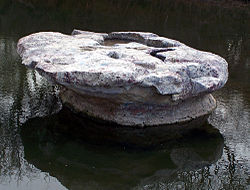
The "round rock" of Round Rock, Texas, in Brushy Creek along the historic Chisholm Trail
In 1851, a small community was formed on the banks of Brushy Creek, near a large round and anvil-shaped rock in the middle of the creek. This round rock marked a convenient low-water crossing for wagons, horses, and cattle. The first postmaster called the community "Brushy", and the creek was called "Brushy Creek", but in 1854, at the suggestion of the postmaster, the small settlement was renamed Round Rock in honor of this now famous rock.[10] After the Civil War, Jesse Chisholm began moving cattle from South Texas through Round Rock on the way to Abilene, Kansas. The route he established, which crossed Brushy Creek at the round rock, became known as the Chisholm Trail.[11] Most of the old buildings, including the old Saint Charles Hotel, have been preserved. This historic area is now called "Old Town".[12]
The Palm House Museum in Round Rock
Downtown Round Rock was the site of a historic gunfight and subsequent capture (and death) of the 19th-century American train robber Sam Bass,[13] by the Texas Ranger Division on July 19, 1878. The Rangers followed Bass and his gang after they robbed the Fort Worth-to-Cleburne train. Bass was tracked to Round Rock, and as he attempted to flee, Bass was shot and killed in a gun battle by Ranger George Herold and Ranger Sergeant Richard Ware. Sheriff's Deputy A.W. Grimes was killed in the shootout. Near Ware was Soapy Smith, a noted con man, and his cousin Edwin, who witnessed Ware's shot. Soapy exclaimed, "I think you got him."[14] The event is known locally as the "Sam Bass Shootout".[15] This shootout is recreated each year at the July 4 Frontier Days Celebration in Old Settlers Park. Bass is buried in Round Rock Cemetery, northwest of "Old Town" on Sam Bass Road. His original headstone can be found on display at the Round Rock Public Library.[16]
20th-century history
[edit]
Cotton
[edit]
In the first half of the 20th century, the county's wealth came from the cotton fields.[17] Cotton, row crops, grapes, and truck farming were the predominant subsistence east of Interstate 35. West of the Balcones divide, ranchers raised cattle, sheep, and to a lesser extent, goats.[18] Due to Round Rock's favorable geographic location over the rich, fertile "blackland prairie" soils also known locally as the "black waxy"[19] (due to the soil's high clay content), cotton was the largest economic driver at that time. Because of the soil and climate, this ecoregion is ideally suited to crop agriculture. Nearby Taylor, Texas, east of Round Rock, was the primary cotton center where the crop was hauled for ginning (its seeds mechanically removed) at the cotton gin, compressed into bales, and shipped by train. Austin was also a cotton center for a time once the railroad arrived there in the 1870s.[20] Cotton production and cattle raising, on a much smaller scale, continues today, although primarily east of Round Rock.
Chisholm Trail Crossing Park
[edit]
To preserve the heritage of the famous crossing, a Chisholm Trail Crossing Park was developed to provide visitors with a simulated scene of Round Rock's historical role in the Chisholm cattle drive. Commemorative plaques in the park tell of the history of Round Rock. The bronze sculptures of four steers with pioneer woman Hattie Cluck and her son, Emmitt, were commissioned by the city through donations from Round Rock residents. The sculptures depict Round Rock's history as a crossing location along the Chisholm Trail.[21] The project plans include 18 to 20 additional bronze statues over time.
Old Settlers Association
[edit]
The entrance to the Old Settlers Association facilities in Round Rock, Texas
Following the end of the American Civil War, a group of Confederate veterans held a reunion in Georgetown on August 27, 1904, for the old settlers of Williamson County and their descendants. The invitation promised "good music, plenty to eat, and above all a warm welcome." The event was well-attended, and reunions—now called Old Settlers Association (OSA) reunions—have been held annually ever since. After the initial one, the event was moved to Round Rock and eventually a structure was built (along with three restored log cabins) in the Palm Valley area of Round Rock, in front of Old Settlers Park, just off Highway 79 in east Round Rock. All members of the organization are descendants of Williamson County residents prior to 1904. OSA has about 50 active members and 300 members in all.[22] The Old Settlers Association today is a social and educational group, with the purpose of facilitating social activities, as well as collecting and preserving important historical information and facts. The facilities are rented for meetings, arts and craft and collectable shows, events, parties, weddings and rehearsal dinners.[23]
Economic impact of Interstate 35
[edit]
In the 1950s, planners of the new Interstate Highway System proposed to route Interstate 35 through Taylor, whose population and cotton industry made it the county's economic powerhouse. Highway Commissioner DeWitt Greer called for the "interregional" highway to go through Taylor on its way from Dallas to Austin, but some Taylor leaders and other citizens fought the idea, worried about the possibility of cutting farmers off from all or part of their fields, traffic noise, damage to country life, loss of farmland, and unwanted right-of-way acquisition—it was proposed to be an astounding 300 feet (90 m) wide, unheard of before this time. No one even knew what an "Interregional Highway" would look like, unless they had traveled to Germany to see the Autobahn or the Merritt Parkway in Connecticut. Instead, they wanted improvements to the farm-to-market roads and a straight route to Austin.[24]
Meanwhile, Round Rock leaders sought the highway and its potential economic benefits. Mayor Louis Henna lobbied the Highway Commission. In June 1956, the 15-year debate over the form, funding, and route of the Interstate was resolved.[25] Due to the heavy lobbying, and not wanting to antagonize Taylor, the highway was built along the edge of the Balcones Fault line, running through Round Rock. The precise route was not without opposition, however, as the new road cut off "Old Town" to the west from what had become the more recent "downtown" area east of Interstate 35.[26] The Interstate eventually made Round Rock into a viable and vibrant commercial center, while Taylor withered with the decline of the cotton industry. Today, it is a minor, modest town with a smaller population, while Round Rock has thrived and rapidly grown into the largest city in the county, attracting Dell Computer and major retail centers.[27] The transformation of Round Rock is detailed in a book by Linda Scarborough (publisher of the Williamson County Sun newspaper) titled Road, River and Ol' Boy Politics: A Texas County's Path from Farm to Supersuburb published by Texas State Historical Press.[19]
Life as a suburb community
[edit]
By the 1990s, Round Rock was primarily a suburb, with the majority of its employed residents working in Austin and then returning home after work to places such as Round Rock and Georgetown, where housing and land were less expensive. In the 1990s, Round Rock had few major employers and jobs other than local retail and other services, or ranching and farming.[8] In the late 1990s, though, that began to change as economic development became a major focus of the city and the Chamber of Commerce. Dell Corporation moved its headquarters to Round Rock, which has provided a significant number of jobs with 16,000 employees at its Round Rock headquarters.[28][29](See also the Business and economic development section in this article.)
Geography
[edit]
Further information: Cambria Cavern
Round Rock is 17 miles (27 kilometers) north of downtown Austin, and 10 mi (16 km) south of Georgetown. Its elevation is 709 ft (216 m).[citation needed] According to the US Census Bureau, the city has an area of 26.3 square miles (68 km2), of which 26.1 square miles (68 km2) are land and 0.1 square miles (0.26 km2) (0.50%) is covered by water.[30] Prior to the 2010 census, the city annexed part of the Brushy Creek CDP, increasing its area to 35.9 square miles (93 km2), of which 35.6 square miles (92 km2) of it is land and 0.3 square miles (0.78 km2) is water.[31][32]
Climate
[edit]
The climate in this area is characterized by generally hot, humid summers and mild, cool winters. According to the Köppen climate classification, Round Rock has a humid subtropical climate, Cfa on climate maps.[33]
Climate data for Round Rock, Texas
Month
Jan
Feb
Mar
Apr
May
Jun
Jul
Aug
Sep
Oct
Nov
Dec
Year
Record high °F (°C)
88
(31)
100
(38)
96
(36)
96
(36)
102
(39)
109
(43)
105
(41)
107
(42)
109
(43)
99
(37)
92
(33)
88
(31)
109
(43)
Mean daily maximum °F (°C)
60
(16)
65
(18)
73
(23)
79
(26)
85
(29)
91
(33)
95
(35)
96
(36)
90
(32)
82
(28)
70
(21)
62
(17)
79
(26)
Mean daily minimum °F (°C)
35
(2)
39
(4)
46
(8)
54
(12)
62
(17)
69
(21)
71
(22)
70
(21)
64
(18)
55
(13)
45
(7)
37
(3)
54
(12)
Record low °F (°C)
8
(−13)
9
(−13)
18
(−8)
22
(−6)
34
(1)
50
(10)
55
(13)
50
(10)
36
(2)
19
(−7)
10
(−12)
−3
(−19)
−3
(−19)
Average precipitation inches (mm)
2.39
(61)
2.45
(62)
2.18
(55)
3.31
(84)
5.00
(127)
3.66
(93)
1.68
(43)
2.30
(58)
3.27
(83)
4.38
(111)
3.34
(85)
2.58
(66)
36.54
(928)
Average snowfall inches (cm)
0.1
(0.25)
0
(0)
0
(0)
0
(0)
0
(0)
0
(0)
0
(0)
0
(0)
0
(0)
0
(0)
0
(0)
0
(0)
0.1
(0.25)
Source: [34]
The city was heavily damaged by a high-end EF2 tornado on March 21, 2022. The tornado continued well northeast of the city afterwards, causing additional damage before dissipating. Sixteen people were injured.[35]
Demographics
[edit]
Historical population
Census
Pop.
Note
%±
1880
628
—
1890
1,438
129.0%
1900
1,138
−20.9%
1910
1,245
9.4%
1920
900
−27.7%
1930
1,005
11.7%
1940
1,173
16.7%
1950
1,683
43.5%
1960
2,458
46.0%
1970
2,811
14.4%
1980
12,740
353.2%
1990
30,923
142.7%
2000
61,136
97.7%
2010
99,887
63.4%
2020
119,468
19.6%
2022 (est.)
126,697
[3]
6.1%
Round Rock city, Texas – Racial and ethnic composition Note: the US Census treats Hispanic/Latino as an ethnic category. This table excludes Latinos from the racial categories and assigns them to a separate category. Hispanics/Latinos may be of any race.
Race / Ethnicity (NH = Non-Hispanic)
Pop 2000[36]
Pop 2010[37]
Pop 2020[38]
% 2000
% 2010
% 2020
White alone (NH)
40,113
53,924
56,027
65.61%
53.99%
46.90%
Black or African American alone (NH)
4,560
9,254
11,552
7.46%
9.26%
9.67%
Native American or Alaska Native alone (NH)
210
288
312
0.34%
0.29%
0.26%
Asian alone (NH)
1,727
5,056
9,668
2.82%
5.06%
8.09%
Pacific Islander alone (NH)
5
105
177
0.09%
0.11%
0.15%
Some Other Race alone (NH)
69
167
714
0.11%
0.17%
0.60%
Mixed race or multiracial (NH)
891
2,135
5,274
1.46%
2.14%
4.41%
Hispanic or Latino (any race)
13,511
28,958
35,744
22.10%
28.99%
29.92%
Total
61,136
99,887
119,468
100.00%
100.00%
100.00%
As of the 2020 United States census, there were 119,468 people, 41,896 households, and 29,962 families residing in the city. The 42,580 housing units had 32,338 owner-occupied homes with a median value of $172,500. Of the 41,896 households, 29.7% had children under the age of 18 living with them, 60.5% were married couples living together, 11.0% had a female householder with no husband present, and 24.4% were not families. About 18.1% of all households were made up of individuals, and 3.0% had someone living alone who was 65 years of age or older. The average household size was 2.87, and the average family size was 3.29.
In the city, the age distribution was 31.9% under 18, 8.5% from 18 to 24, 38.8% from 25 to 44, 16.3% from 45 to 64, and 4.5% who were 65 or older. The median age was 32 years. For every 100 females, there were 98.6 males.
The per capita income for the city was $30,605.
Round Rock, with a population of more than 130,000, is located 15 miles north of Austin in the Central Texas Hill Country. It is the 28th most populous city in Texas, according to Texas Demographic Center.[39]
Economy
[edit]
The Texas Guaranteed Student Loan Corporation headquarters in Round RockDell headquarters in Round Rock
The City of Round Rock has maintained a high quality of life while becoming a major center for economic growth in Central Texas, with industry clusters in clean energy, advanced manufacturing, life sciences, and computer/software development.[11]
Round Rock has more than 20 major employers[40] including: Cerilliant Corporation, Cintas, Dell, Dresser, Emerson Process Management, Hospira, IKEA, KoMiCo Technology Inc., Round Rock Premium Outlets, Prudential Overall Supply, Sears Customer Care, Texas Guaranteed Student Loan Corp, Tekscend Photomask, and TECO-Westinghouse.[11]
Dell corporate headquarters
[edit]
Dell, a multinational computer and information technology corporation based in Round Rock, develops, sells and supports computers and related products and services. The company employs about 11,500 people in the Round Rock facilities,[29] and as of 2017, about 138,000 people worldwide.[41] Dell was originally based in Austin after its formation in 1984 as PC's Limited by UT college student Michael Dell. With the need for significant space as it expanded, the City of Round Rock in 1996 offered Dell a "Chapter 380" agreement by offering to split sales tax revenue from in-state sales 50/50 between Dell and the city. (A "Chapter 380" agreement is named for the chapter in Vernon's Statues that permits sales tax revenue sharing for economic development purposes.) It was the first time such an agreement had been used in Central Texas and among the first in the state.[42] As of 1999, approximately half of the general fund of the City of Round Rock originates from sales taxes generated from the Dell headquarters.[42] Today, the company is one of the largest technology companies in the world, listed as number 38 on the Fortune 500 (2010). Fortune also lists Dell as the #5 most admired company in its industry. As part of its clean energy program in 2008, Dell switched the power sources of the Round Rock headquarters to more environmentally friendly ones, with 60% of the power coming from TXU Energy wind farms and 40% coming from the Austin Community Landfill gas-to-energy plant operated by Waste Management, Inc.
Commercial and retail
[edit]
Round Rock's largest commercial and office business center is La Frontera, at the intersection of Loop 1, SH 45, and IH-35. La Frontera combines multi-tenant offices, company headquarters facilities, 1,000,000 square feet (90,000 m2) of retail,[43] and several apartment complexes and other smaller retail and housing centers. The project also includes Williamson County's largest hotel, the Austin North Marriott, which provides space for large conferences, meetings, and banquets — a first for the county and an important component of Round Rock's economic efforts.[44] The center is also home to the Texas Guaranteed Student Loan Corporation,[45] and Emerson Process Management. The retail portion is the second-largest outdoor commercial project in the Austin-Round Rock metro area.[46] La Frontera was developed by Bill Smalling and Don Martin, with Fort Worth financier Ed Bass as financial partner.
In 2006, a retail-only hub opened in Round Rock at the corner of IH-35 and Highway 1431 (now renamed "University Boulevard"), across the street from IKEA.[47] The major-retailer center includes the Simon Property Group's Premium Outlets Mall, as well as numerous other retail stores and restaurants. The project was developed by Simon Property Group, with other portions by Barshop and Oles of Austin.
Round Rock is also the home of the 'World Famous' Round Rock Donuts, which was founded in 1926.[48]
Sports
[edit]
A view of the third-base stands of the Dell Diamond, home of the Round Rock Express
Round Rock is home to the Round Rock Express, a Triple-A Minor League Baseball team of the Pacific Coast League,[49] owned by RSR Sports (Nolan Ryan, Don Sanders, Reid Ryan) and was founded by Reid Ryan, son of Baseball Hall of Famer Nolan Ryan. As of August 2010, Nolan Ryan is also the new owner of the major league Texas Rangers ball club.[50] Home games for the Express are played at the Dell Diamond, a facility that is owned by the City of Round Rock and leased long-term to RSR Sports, which runs and maintains the facility.
Round Rock opened a free public skate park in 2007[51] behind the Clay Madsen Recreation Center on Gattis School Road.[52]
Round Rock is the self-proclaimed "Sports Capital of Texas".[53] The city's Old Settlers Park offers a professionally designed disc golf course, cricket, cross country running, twenty-field baseball complex, five-field softball complex, and seven soccer facilities in addition to the Rockin' River Family Aquatic Center.[54]
The 11th annual US Quidditch Cup championship quidditch tournament was hosted in Round Rock in April 2018.[55]
Government
[edit]
City government
[edit]
The city of Round Rock is managed through a council-manager form of government. The city council is composed of six city council members and the mayor. The mayor and all council members are elected at large and serve the entire city, not by geographic precincts. The mayor pro tem is appointed annually by council members.[56] City Council positions are not full-time jobs. The council appoints a full-time city manager, who manages the daily affairs of the city, and all council meetings are held at 221 E. Main Street, in downtown Round Rock, on the second and fourth Thursdays of each month at 7 pm, unless indicated otherwise. Council meetings are televised.[57]
County government
[edit]
The Commissioners Court[58] is the overall governing and management body of Williamson County, consisting of five members. The county judge presides as chairman over the court, and is elected every four years by all voters in the county. Four commissioners are elected by single-member precincts every four years. While the majority of Round Rock is within Precinct 1, all four precincts include some portions of the city.
State and national representation
[edit]
Texas House of Representatives: State Representative District 52: Caroline Harris (R)
Texas Senate District 5: Charles Schwertner (R)[59]
US Congress – Congressman John R. Carter (R), Congressional District 31[59]
US Congress – Congressman Michael McCaul (R), Congressional District 10[59]
Other political subdivisions
[edit]
Municipal utility districts, commonly referred to as "MUDs", play a significant role in Round Rock. Each is a special-purpose district that provides public utilities such as water, wastewater, storm water, and sometimes roads, parks, solid waste, and other infrastructure and services to the residents of each district. MUDs are typically formed by a residential developer as a means to install utilities and roads to a project when a city is not ready or able to provide them. The developer gets reimbursed over time from the fees levied by the MUD, and at some point the area may be annexed by the city to bring the development into the city's tax base once the basic infrastructure costs are paid off.[60] The MUD is represented by its own board of directors, who are voted on by the residents of the district, and it has the authority to condemn land, add additional land area, and levy fees in lieu of property taxes to maintain the utilities and other facilities.
Ten MUDs are in Round Rock: Brushy Creek, Fern Bluff, Highlands at Mayfield Ranch, Meadows at Chandler Creek, Paloma Lake, Parkside at Mayfield Ranch, Siena, Teravista, Vista Oaks, and Walsh Ranch. Total population living within these MUDs is 47,648 (2010 city estimate).[61]
Round Rock's largest district is Brushy Creek Municipal Utility District.[62] Brushy Creek MUD was formed as Williamson County Municipal Utility District No. 2 in October 1977 with 725 acres (2.9 km2) of land. An annexation in 1983 increased the District to 2,210 acres (8.9 km2). The district name was changed to Brushy Creek Municipal Utility District in August 1990. The MUD provides a wide range of city-like services including parks and recreation, full utilities, road maintenance and a Home Owner's Association. Services a MUD can offer, however are also limited by law (for example they cannot offer library services).
Another similar but somewhat smaller MUD in Round Rock's is Fern Bluff Municipal Utility District[63] in the Wyoming Springs area of town. Both MUDs play a significant role in local governance and maintenance of basic utilities.
From time to time, elections to the boards were contentious and heated debates arose regarding other MUD issues.[64] Round Rock does not often annex a MUD to avoiding having to take on the aging infrastructure replacement and upkeep costs.
Education
[edit]
Public education
[edit]
Round Rock's main public library branch on Main Street in the city's historic downtown area
Public education is administered by the Round Rock Independent School District. The district includes southern Williamson County and northwest Travis County, and portions of Austin and Cedar Park.[65]
Elementary Schools in Round Rock:[66]
Berkman Arts Integration Academy
Blackland Prairie Leadership Academy
Bluebonnet Elementary School
Brushy Creek Elementary School
Cactus Ranch Elementary School
Caldwell Heights Elementary IB World School
Callison Elementary School
Chandler Oaks IB World School
Deep Wood Elementary School
Double File Trail Elementary Leadership Academy
Fern Bluff Elementary School
Forest Creek Elementary School
Gattis Elementary School
Great Oaks Elementary Leadership Academy
Herrington Elementary School
Old Town Elementary School
Redbud Elementary School
Robertson Elementary School
Teravista Elementary Leadership Academy
Union Hill Elementary School
Voigt Arts Integration Academy
Middle and high schools in Round Rock:[67][68]
*
C.D. Fulkes Middle School
Canyon Vista Middle School
Cedar Ridge High School
Cedar Valley Middle School
Chisholm Trail Middle School
Deerpark Middle School
Early College High School
Grisham Middle School
Hernandez Middle School
Hopewell Middle School
Pearson Ranch Middle School
Ridgeview Middle School
Round Rock High School
Stony Point High IB World School
Success High School
Walsh Middle School
Higher education
[edit]
The Avery Building on the Round Campus of Texas State University
Texas State University Round Rock Campus provides training program for work at local companies, such as Dell. In 2009, 1,700 students were enrolled.[69]
A campus of Texas A&M Health Science Center opened in Round Rock in 2010.[70]
A campus of Austin Community College opened in 2010.[71][72]
The School of Nursing at Texas State University in Round Rock offers programs in health information management, health services research, and physical therapy.[73][74]
Media
[edit]
Filming location
[edit]
In 1998, the Texas Chainsaw House featured in the 1974 horror movie, The Texas Chain Saw Massacre, was moved from Round Rock to Kingsland, Texas, where it was fully restored.[75]
The 1974 horror movie The Texas Chain Saw Massacre was filmed at various central Texas locations with a majority shot at two houses in Round Rock.[75] Tours of local sites are available.[76]
A majority of the 2002 film The Rookie was shot at and around the minor-league baseball stadium in Round Rock known as Dell Diamond.[77]
Infrastructure
[edit]
Transportation
[edit]
Major highways
[edit]
I-35
US 79 (the southern terminus)
State Highway 45
State Highway 45 Toll Rd
State Highway 130 Toll Rd
The interchange of Interstate 35 and State Highway 45 under construction in 2004
Health care
[edit]
Seton Williamson opened in 2008
Hospitals and health care services serve not only Round Rock and the greater Williamson County area, as well as North Austin.[78] These include:
Saint David's Round Rock Medical Center, opened in 1984. It is a for-profit hospital with a Level II Trauma center.[79]
Scott & White Memorial Hospital, opened in 2007. The facility has full hospital services, and transfers some patients to its primary Temple campus.
Ascension Seton Williamson,[80] opened in 2009. A level II trauma center next to the Texas State University campus.[81]
Notable people
[edit]
Barbette, female impersonator[82][83]
John Carter, U.S. representative[84]
Juanita Craft, politician and civil rights activist[85][86]
Ryan Goins, professional baseball player
Colleen LaRose, alleged terrorist[87][88]
Donnie Little, football player[89]
Soapy Smith, confidence man and gangster[90][91][92]
Billie Lee Turner, botanist
Anike, formerly known as Wande, rapper and A&R administrator[93]
Jarrett Allen, professional basketball player
James Lynch, professional football player
Mason Thompson, professional baseball player
Deuce Vaughn, professional football player
Sister cities
[edit]
City of Lake Macquarie, became a sister city in 1985.[94]
Sabinas Hidalgo, Nuevo León, became a sister city in 1991.[94]
See also
[edit]
Library resources about Round Rock, Texas
Resources in your library
Resources in other libraries
Handbook of Texas
Round Rock Public Library
Notes
[edit]
References
[edit]
^
"2019 U.S. Gazetteer Files". United States Census Bureau. Retrieved August 7, 2020.
^ abU.S. Geological Survey Geographic Names Information System: Round Rock, Texas
^ ab"City and Town Population Totals: 2020-2021". United States Census Bureau. July 3, 2022. Retrieved July 3, 2022.
^"Bureau of Labor Statistics for Austin-Round Rock, Texas, Metropolitan Area".
^"Census - Geography Profile: Round Rock city, Texas". United States Census Bureau. Retrieved February 27, 2022.
^Balcones Escarpment from the Handbook of Texas Online. Retrieved May 11, 2010. Texas State Historical Association
^Hall, Christine (April 28, 2010). "Cyberstates: Texas second-largest tech employment". Austin Business Journal. Retrieved May 4, 2010.
^ abThompson, Karen R.; Jane H. Digesualado (1985). Historical Round Rock Texas. Austin, Texas: Nortex Press (Eakin Publications). p. 78.
^Thompson, Karen R.; Jane H. Digesualado (1985). Historical Round Rock Texas. Austin, Texas: Nortex Press (Eakin Publications). pp. 16, 17. OCLC 12119831.
^"The Round Rock". Texas Historical Markers. Retrieved August 31, 2023.
^ abc"City of Round Rock profile". Roundrocktexas.gov. Retrieved July 23, 2010.
^"A Brief History of Round Rock". Roundrocktexas.gov. Archived from the original on April 19, 2010. Retrieved March 19, 2010.
^"Bass, Sam Handbook of Texas entry".
^Smith, Jeff (2009). Alias Soapy Smith: The Life and Death of a Scoundrel, Klondike Research. pp. 30–32. ISBN 0-9819743-0-9
^"The Officer Down Memorial Page on A. W. Grimes".
^"City of Round Rock – Sam Bass". Roundrocktexas.gov. Archived from the original on May 29, 2010. Retrieved March 19, 2010.
^Scarbrough, Linda (2009). Road, River and Good Ol' Boy Politics: A Texas County's Path from Farm to Supersuburb. Austin, Texas: Texas State Historical Association. p. 22. ISBN 978-0-87611-202-1.
^Scarbrough, Linda (2009). Road, River and Good Ol' Boy Politics: A Texas County's Path from Farm to Supersuburb. Austin, Texas: Texas State Historical Association. p. 82. ISBN 978-0-87611-202-1.
^ abScarbrough, Linda (2009). Road, River and Good Ol' Boy Politics: A Texas County's Path from Farm to Supersuburb. Austin, Texas: Texas State Historical Association. ISBN 978-0-87611-202-1.
^Scarbrough, Linda (2009). Road, River and Good Ol' Boy Politics: A Texas County's Path from Farm to Supersuburb. Austin, Texas: Texas State Historical Association. pp. 250–251. ISBN 978-0-87611-202-1.
^Torres, Edward (February 23, 2009). "Recalling family connections along Round Rock's old Chisholm Trail". Round Rock Leader. Archived from the original on July 15, 2011.
^Stansbury, Amy (July 3, 2008). "Round Rock Old Settlers Association". Community Impact Newspaper. Archived from the original on April 11, 2010.
^Thompson, Karen R.; Jane H. Digesualado. Historical Round Rock Texas. Austin, Texas: Nortex Press (Eakin Publications).
^Scarbrough, Linda (2009). Road, River and Good Ol' Boy Politics: A Texas County's Path from Farm to Supersuburb. Austin, Texas: Texas State Historical Association. pp. 53–256. ISBN 978-0-87611-202-1.
^Scarbrough, Linda (2009). Road, River and Good Ol' Boy Politics: A Texas County's Path from Farm to Supersuburb. Austin, Texas: Texas State Historical Association. p. 271. ISBN 978-0-87611-202-1.
^Scarbrough, Linda (2009). Road, River and Good Ol' Boy Politics: A Texas County's Path from Farm to Supersuburb. Austin, Texas: Texas State Historical Association. p. 257. ISBN 978-0-87611-202-1.
^Scarbrough, Linda (2005). Road, River and Good Ol' Boy Politics: A Texas County's Path from Farm to Supersuburb. Austin, Texas: Texas State Historical Association. p. 259. ISBN 978-0-87611-202-1.
^"Dell Worldwide." Dell. Retrieved on May 4, 2010.
^ abHall, Christine. "Cyberstates: Texas second-largest tech employment." Austin Business Journal. Wednesday April 28, 2010. Retrieved on May 4, 2010.
^"Round Rock (city) QuickFacts from the US Census Bureau". Quickfacts.census.gov. Archived from the original on February 27, 2010. Retrieved March 19, 2010.
^"Population and Housing Unit Counts, 2010 Census of Population and Housing" (PDF). Texas: 2010. Retrieved January 6, 2017.
^"Boundary Map of Round Rock, Texas". MapTechnica. Retrieved January 6, 2017.
^"Round Rock, Texas Köppen Climate Classification (Weatherbase)". Weatherbase. Retrieved May 3, 2017.
^Monthly Weather-Red Rock, TX
^National Weather Service in Austin, Texas (2022). Texas Event Report: EF1 Tornado (Report). National Centers for Environmental Information. Retrieved December 1, 2022.National Weather Service in Austin, Texas (2022). Texas Event Report: EF2 Tornado (Report). National Centers for Environmental Information. Retrieved December 1, 2022.National Weather Service in Fort Worth, Texas (2022). Texas Event Report: EF1 Tornado (Report). National Centers for Environmental Information. Retrieved December 1, 2022.
^"P004: Hispanic or Latino, and Not Hispanic or Latino by Race – 2000: DEC Summary File 1 – Round Rock city, Texas". United States Census Bureau.
^"P2: Hispanic or Latino, and Not Hispanic or Latino by Race – 2010: DEC Redistricting Data (PL 94-171) – Round Rock city, Texas". United States Census Bureau.
^"P2: Hispanic or Latino, and Not Hispanic or Latino by Race – 2020: DEC Redistricting Data (PL 94-171) – Round Rock city, Texas". United States Census Bureau.
^"Demographic and Census Information". City of Round Rock. Retrieved December 19, 2023.
^"Round Rock Chamber of Commerce: Major Employers". Roundrockchamber.org. Archived from the original on March 8, 2010. Retrieved March 19, 2010.
^"Number of employees at Dell from 1996 to 2017." Statista: The Statistics Portal. Retrieved on April 12, 2019.
^ abJacobs, Janet. "Cash flow from Dell lets Round Rock boost budget." Austin American-Statesman. September 9, 1999. A1. Retrieved on May 4, 2010. "Almost half the city's general fund comes from sales tax at Dell's headquarters."
^"La Frontera Village for sale". Austin Business Journal. June 10, 2002. Retrieved May 30, 2010.
^"Austin Marriott North". Marriott. Retrieved May 3, 2017.
^"Tap into the TG learning center". tgslc.org.
^Novak, Shonda (August 30, 2007). "Deal is milestone for La Frontera". Austin American-Statesman. Austin, Texas. p. D1. Retrieved May 30, 2010
^"Amid much fanfare, IKEA opens to mass crowd on first day", Austin Business Journal, Austin, Texas, November 16, 2006. Retrieved on July 7, 2010.
^Donuts, Round Rock. "Round Rock Donuts". Round Rock Donuts. Retrieved June 24, 2025.
^"Official Site of Minor League Baseball and the Round Rock Express". Archived from the original on March 4, 2010. Retrieved July 5, 2010.
^Garrett, Jon (August 6, 2010). "Ryan victory felt in Round Rock". Round Rock Leader. Archived from the original on July 15, 2011.
^Bowlin, Sean (June 9, 2007). "Skate park to open July 20". Round Rock Leader. Archived from the original on July 15, 2011.
^"Round Rock Skate Park". Retrieved August 11, 2007.
^"Sports Capital of Texas". Sports Capital of Texas. Retrieved March 19, 2010.
^"Game on! Old Settlers Park" Archived July 12, 2010, at the Wayback Machine Retrieved August 3, 2010
^"Round Rock, Texas to host US Quidditch Cup 11 – US Quidditch Cup". usquidditchcup.com. Retrieved April 15, 2018.
^City of Round Rock. "About the Round Rock City Council". City of Round Rock website. Archived from the original on July 12, 2010. Retrieved July 23, 2010.
^City of Round Rock. "About the Round Rock City Council". City of Round Rock website. Archived from the original on July 12, 2010. Retrieved August 3, 2010.
^"Commissioners Court". Archived from the original on July 23, 2011.
^ abc"Texas Tribune Directory".
^Eakens, Kathryn (June 10, 2009). "City to buy regional wastewater system". Round Rock Leader. Archived from the original on July 15, 2011.
^City of Round Rock email from Joel Jordan, City Planning Department, August 12, 2010
^"Home - Brushy Creek MUD". www.bcmud.org. Retrieved May 3, 2017.
^Zachry, Lauri (May 4, 2010). "Stempko, McLaughlin vie for MUD position; Newcomers enter as Bradley departs". Round Rock Leader. Archived from the original on July 15, 2011.
^"Round Rock ISD". Community Impact. Vol. 1, no. 6. July 17, 2007. pp. 18–19.
^"Elementary Schools". Round Rock ISD. Retrieved April 15, 2025.
^"Middle Schools". Round Rock ISD. Retrieved April 15, 2025.
^"High Schools". Round Rock ISD. Retrieved April 15, 2025.
^"RRHECord Newsletter". July 2010. Retrieved August 3, 2010.
^Zachry, Lauri (June 2, 2010). "Area colleges deal with growth, state funding". Round Rock Leader. Archived from the original on July 15, 2011.
^"Round Rock Campus Campus opens on August 23, 2010, for first day of fall classes." Austin Community College Locations: Round Rock Update. Date retrieved August 3, 2010
^Zachry, Lauri (September 5, 2008). "ACC presents preliminary plans for Round Rock campus". Round Rock Leader. Archived from the original on July 15, 2011.
^"Our Story". rrhec.txstate.edu. April 21, 2021.
^"St. David's Nursing now accepting applications for fall 2010". Texas State University. Retrieved September 9, 2009.
^ ab"Howdy Neighbor, can I borrow your saw?". Austin American-Statesman. July 2, 1999.
^Texas Chainsaw Tours ltd website. "Texas Chainsaw Massacre Tours". web site. Retrieved July 23, 2010.
^"The Rookie - 2002". Rotten Tomatoes. Retrieved July 23, 2010.
^Zaragoza, Sandra (December 25, 2009). "Expansion in facilities, services marked decade in health care for Round Rock". Austin Business Journal.
^"About St. David's Round Rock Medical Center" Retrieved August 3, 2010
^Family, Seton Healthcare. "Location & Information for Seton Medical Center Williamson". Retrieved May 3, 2017.
^Vose, Robyn (July 21, 2010). "Seton Williamson is feeling fine; Fifth floor adding 32 beds". Round Rock Leader. Archived from the original on July 15, 2011.
^Williams, Albert (1997). "The Hidden Holocaust". The Chicago Reader. Retrieved May 26, 2008.
^"Victor Victoria". imdb.com. March 19, 1982. Retrieved August 3, 2010.
^"John Carter, U.S. Rep.: Email and phone. Salary, biographical details and latest news". The Texas Tribune. Retrieved October 5, 2025.
^NPS - Civil Rights - Juanita Craft
^Dallas News - Decades after death of Juanita Craft, the Dallas civil rights leader's legacy still looms large - February 14, 2017
^Johnson, Carrie (March 3, 2010). "JihadJane, an American woman, faces terrorism charges". Washington Post.
^"Indictment, U.S. v. LaRose" (PDF). U.S. District Court for the Eastern District of Pennsylvania. March 4, 2010. Retrieved March 10, 2010.
^"Dickinson High School 2013 Homecoming Festivities". Gator Bytes Dickinson Independent School District E-Newsletter. Retrieved October 8, 2013.
^Smith, Jeff (2009). Alias Soapy Smith: The Life and Death of a Scoundrel, Klondike Research. p. 22. ISBN 0-9819743-0-9
^Robertson, Frank C.; Harris, Beth Kay (1961). Soapy Smith: King of the Frontier Con Men. New York City: Hastings House. ISBN 978-0-8038-6661-4. cite book: ISBN / Date incompatibility (help)
^Jeff Smith. "Alias Soapy Smith: King of the Frontier Con Man". Klondike Publishing.
^Ashcraft, Michael (April 12, 2019). "Rising rapper overcame Muslim family opposition to follow Jesus". God Reports. Retrieved March 27, 2020.
^ ab"Political Structure-Sister City Program". City of Round Rock. Retrieved August 13, 2019.
External links
[edit]
Wikimedia Commons has media related to Round Rock, Texas.
City of Round Rock, Texas
Community Center of City of Round Rock, Texas (2013)
Round Rock Chamber of Commerce
v
t
e
Round Rock, Texas
Education
Austin Community College
Round Rock Independent School District
Cedar Ridge HS
Round Rock HS
Stony Point HS
Round Rock Christian Academy
Round Rock Public Library
Texas State University Round Rock Campus
Geography
Chisholm Trail Crossing Park
Koughan Memorial Water Tower Park
Prete Main Street Plaza
Round Rock Cemetery
Round Rock Commercial Historic District
Sports
Dell Diamond
FC Austin Elite
Round Rock Express
Round Rock Multipurpose Complex
Round Rock SC
Related
Immortal Ten Bridge
Round Rock Donuts
v
t
e
Municipalities and communities of Travis County, Texas, United States
County seat: Austin
Cities
Austin‡
Bee Cave
Cedar Park‡
Creedmoor
Elgin‡
Jonestown
Lago Vista
Lakeway
Leander‡
Manor
Mustang Ridge‡
Pflugerville‡
Rollingwood
Round Rock‡
Sunset Valley
West Lake Hills
Travis County map
Villages
Briarcliff
Point Venture
San Leanna
The Hills
Volente
Webberville
CDPs
Barton Creek
Garfield
Hornsby Bend
Hudson Bend
Jollyville‡ (former)
Lost Creek
Manchaca
Shady Hollow
Steiner Ranch
Tanglewood Forest (former)
Wells Branch
Windemere (former)
Other
communities
Bluff Springs
Carl
Carlson
Cedar Valley
Cele
Colton
Del Valle
Dessau
Dunlap
Elroy
Kimbro
Littig
Lund
Marshall Ford
McNeil
Moore's Crossing
New Sweden
Oak Hill
Pilot Knob
Round Mountain
Spicewood‡
Three Points
Turnersville
Ghost towns
Daffan
Decker
Four Points
Fromme
Kincheonville
Maha
Manda
Merrilltown
Montopolis
Nameless
New Katy
Onion Creek
Pleasant Hill
Waters Park
Footnotes
‡This populated place also has portions in an adjacent county or counties
Texas portal
United States portal
v
t
e
Municipalities and communities of Williamson County, Texas, United States
County seat: Georgetown
Cities
Austin‡
Bartlett‡
Cedar Park‡
Coupland
Florence
Georgetown
Granger
Hutto
Jarrell
Leander‡
Liberty Hill
Pflugerville‡
Round Rock‡
Taylor
Thorndale‡
Thrall
Weir
Williamson County map
CDPs
Brushy Creek
Jollyville‡ (former)
Santa Rita Ranch
Serenada
Sonterra
Other
communities
Hare
Jonah
Macedonia
Norman's Crossing
Rice's Crossing
Schwertner
Walburg
Waterloo
Ghost town
Allison
Bagdad
Palm Valley
Footnotes
‡This populated place also has portions in an adjacent county or counties
Texas portal
United States portal
v
t
e
Austin–Round Rock–San Marcos
Central city
Austin
Satellite cities
Cedar Park
Georgetown
Pflugerville
Round Rock
San Marcos
Other
communities
Bastrop
Buda
Burnet
Elgin
Hudson Bend
Hutto
Jollyville
Kyle
Lago Vista
Leander
Lakeway
Lockhart
Lost Creek
Luling
Manor
Marble Falls
Taylor
Smithville
Wells Branch
West Lake Hills
Wimberley
Windemere
Wyldwood
Counties
MSA/CSA
Bastrop
Burnet
Caldwell
Hays
Travis
Williamson
Outlying
Blanco
Burleson
Colorado
Fayette
Gillespie
Lee
Llano
Milam
Washington
Parks and
preserves
Balcones Canyonlands
Bastrop
Emma Long
Enchanted Rock
Hippie Hollow
Indiangrass
Longhorn Cavern
McKinney Falls
Mount Bonnell
Onion Creek
Pedernales Falls
John Stokes
Wild Basin
Zilker
Geography
Austin Chalk
Balcones Fault
Edwards Aquifer
Edwards Plateau
Highland Lakes
Hill Country
Llano Uplift
Bodies of
water
Barton Creek
Barton Springs
Colorado River
Granger Lake
Lady Bird Lake
Lake Austin
Lake Georgetown
Lake Marble Falls
Lake Travis
Lake Walter E. Long
Pedernales River
San Gabriel River
San Marcos River
Transportation
Capital Area Rural Transportation System
v
t
e
State of Texas
Austin (capital)
Topics
Outline
Architecture
Climate (Climate change)
List of counties in Texas
Cuisine
Dialects
Geography
Government
Healthcare
History
Languages
Law
Literature
Mass media
Newspapers
Radio
TV
National Historic Landmarks
National Register of Historic Places Sites
Recorded Texas Historic Landmarks
Sports
Symbols
Texans
Time
Tourist attractions
Transportation
Society
Abortion
Culture
Crime
Demographics
Economy
Education
Gambling
Gun laws
Homelessness
LGBTQ rights
Pride
Politics
Regions
Ark‑La‑Tex
Big Bend
Boca Chica
Blackland Prairies
Brazos Valley
Central Texas
Coastal Bend
Concho Valley
Cross Timbers
East Texas
Edwards Plateau
Golden Triangle
Hill Country
Llano Estacado
Northeast Texas
North Texas
Osage Plains
Panhandle
Permian Basin
Piney Woods
Rio Grande Valley
Southeast Texas
South Plains
South Texas
Texoma
Trans-Pecos
West Texas
Metropolitan
areas
Abilene
Amarillo
Austin–Round Rock (Greater Austin)
Beaumont–Port Arthur
Brownsville–Harlingen
College Station–Bryan
Corpus Christi
Dallas–Fort Worth–Arlington (DFW)
El Paso
Houston–The Woodlands–Sugar Land (Greater Houston)